TSUSHIMA
October 2020
Philip Rowe
Last week I spent several days on Tsushima, which I visited to expand my horizons and gain new experience.
Tsushima is an extremely mountainous island, with a population of 30,000, located between Kyushu and Korea. Sadly, the majority of the island’s mountains are tree farms, dramatically reducing wildlife diversity. Tidal wetlands are few and far between, most of the river beds are nearly dry this time of year, and there are only three or four beaches. The prime birding spots, as a result, are in just a handful of localized areas. For sightseeing, there is a bit here and there, but be aware that the viewpoint from which you can see Korea works probably only after a typhoon or on a clear winter day.
For birders, Tsushima is perhaps best known for the Chinese Sparrowhawk migration that occurs in September, but it is also one of the main stopover points for migrating birds. I hired an island guide for a quick knowledge download, which I will share here.
As the mountains are extremely steep, there appears to be limited opportunity to reach birds at high elevations or along the slopes, and my guide said there were no accessible forestry roads of value. The best season is the spring, with buntings arriving in large flocks in April. Golden Week is the peak season for out-of-prefecture birders, which is no surprise. Tsushima gets its fair share of unique birds, such as Black-capped Kingfisher, but sighting one of these during spring migration would be really lucky.
In the spring, the southern part of the island is better. One of the first places that birds land is around Tsutsusaki Lighthouse (https://goo.gl/maps/p8LzmEsghQ8C6BS97), where one can also find one of the many resident Peregrines. There is a nice footpath that goes around the point, and one should be able to find birds on the access roads. The birds then congregate to feed in the few rice fields on the southern half of the island. I found all the locations that my guide showed me afterwards via Google Maps using the satellite view.
The fields around Sago, on the northern part of the island, are interesting as well (34°37'29.994" N 129°20'40.542" E ). During September, it is possible to see the Tsushima Yamaneko (Tsushima Leopard Cat) during the day on the strips of land between the rice fields there. During the spring, spoonbills may be found here: 34.278524, 129.291187. The Black-faced Spoonbill I saw on this trip was located at 34°32'13.476" N 129°20'21.216" E, which also appears to be a regular spot for this species.
Although the prime locations are relatively small, Tsushima itself is a huge island. I ended up driving hundreds of kilometers while there. I stayed in the middle of the island, but reaching the northernmost spots takes well over an hour given the 70+ km distance on local roads. The southern spots, such as the lighthouse, also take that long. The sheer scale of the island, the steep hills, where birds can land and rest and avoid prying birders, and the lack of diverse ecosystems make Tsushima far less than an ideal birding island.
One thing I noticed on this trip was that so many the small birds were constantly looking up! Very skittish. With all the passing Eurasian Sparrowhawks, I guess they had good reason to be scared!
The man who showed me around was an excellent guide but speaks no English. His book on Tsushima birds and wildlife is listed here.
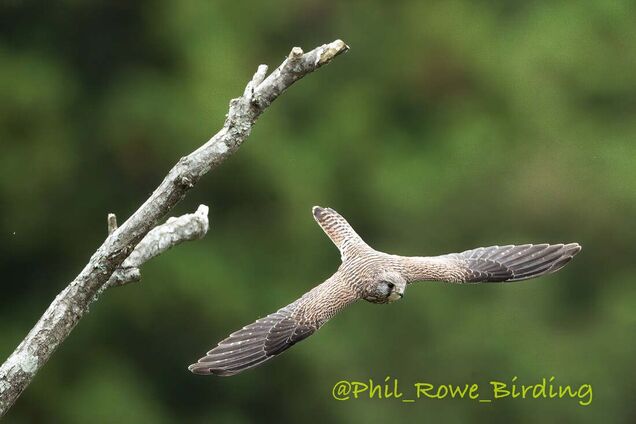
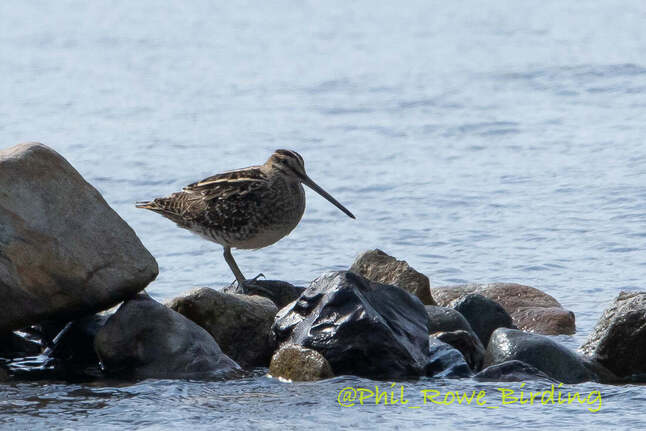
Unfortunately, the days of my visit were slow ones birding-wise. I saw 50-something species but found only one new species and a snipe that I couldn’t positively identify—nor could my guide. Overall, I found very few wading bird species—many Grey Herons, several egrets, one Common Sandpiper, and the snipe (which appears to have been a Common Snipe). The island is teeming with Black Kites (I was told to be careful eating lunch around them). There were also many Eurasian Sparrowhawks, Common Kestrels, Rooks, stonechats (still working on the exact species) [probable Stejneger's— ed.], and Daurian Redstarts passing through. I was a bit surprised to see Mandarin Ducks here and there as well. The guide said that they breed on the island.
On my last morning before I headed to the airport, the fields near my lodging were full of small birds, with small flocks flying here and there. I couldn't stay to observe, but they appeared to be heading to the hillsides, rather than the lowland rice fields. Now that I have the lay of the land, I will probably head back next spring. I am also interested in Iki Island, which is closer to Kyushu than Tsushima and much smaller, with its highest point just 200 meters ASL.
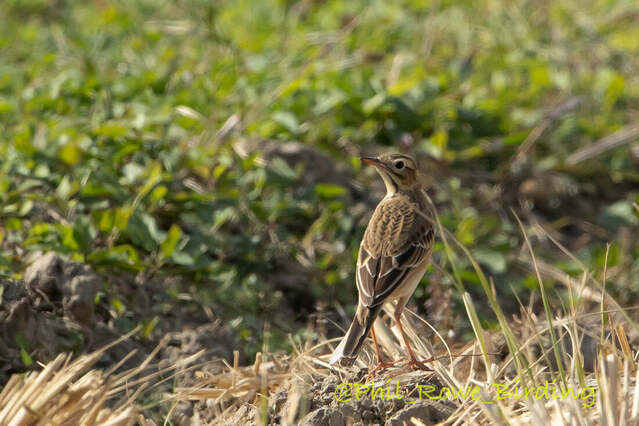
A special thanks to all who correctly called my mistake on the Richard's Pipit. I had simply moved my eyes too quickly in my book and entered the English name of the bird following the RIchard's Pipit. Careless error.
TRIP LIST:
1. Black Kite - Tobi
2. Black-faced Spoonbill - Kaozura-hera-sagi
3. Black-tailed Gull - Umineko
4. Brambling - Atori
5. Brown-eared Bulbul - Hiyodori
6. Buff-bellied Pipit - Ta-hibari
7. Bull-headed Shrike - Mozu
8. Carrion Crow - Hashiboso-garasu
9. Common (Japanese) Buzzard - Nosuri
10. Common Kestrel - Chogenbo
11. Common Kingfisher - Kawasemi
12. Common Pochard - Hoshi-hajiro
13. Common Sandpiper - Iso-shigi
14. Common Starling - Hoshi-mukudori
15. Daurian Redstart - Jobitaki
16. Eurasian Coot - O-Ban
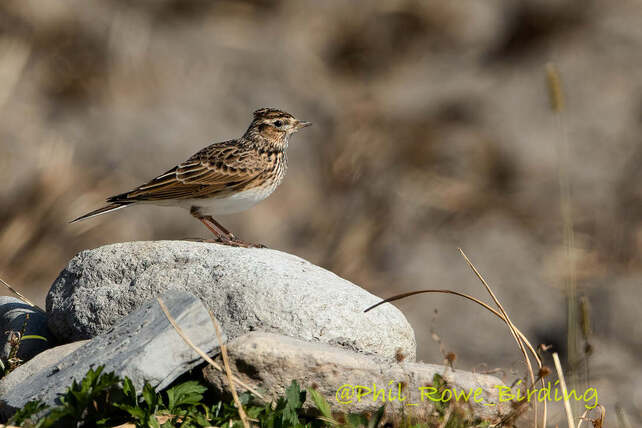
17. Eurasian Skylark - Hibari
18. Eurasian Sparrowhawk - Hai-taka
19. Eurasian Wigeon - Hidorigamo
20. Grey Wagtail - Ki-sekirei
21. Great Cormorant - Kawa-u
22. Great Egret - Dai-Sagi
23. Grey Heron - Ao-sagi
24. Japanese Bush Warbler - Uguisu
25. Japanese Tit - Shijugara
26. Japanese White-eye - Mejiro
27. Large-billed Crow - Hashibuto-garasu
28. Little Bunting - Koho-aka
29. Little Egret - Ko-sagi
30. Little Grebe - Kaitsuburi
31. Mallard - Ma-gamo
32. Mandarin Duck - Oshidori
33. Meadow Bunting - Hojiro
34. Northern Pintail - Onaga-gamo
35. Common Snipe - Tashigi
36. Olive-backed Pipit - Binzui
37. Oriental Turtle Dove - Kiji-bato
38. Western Osprey - Misago
39. Richard’s Pipit - Mamijiro-tahibari
40. Rock Dove - Do-bato
41. Rook - Miyama-garasu
42. Rustic Bunting - Kashira-taka
43. Spot-billed Duck - Karu-gamo
44. (Stejneger's) Stonechat - No-bitaki
45. Taiga Bean Goose - O-Hishikui
46. Eurasian Tree Sparrow - Suzume
47. Varied Tit - Yama-gara
48. White Wagtail - Haku-sekirei
49. White-cheeked Starling - Mukudori
50. Yellow-throated Bunting - Miyama-hojiro